Not another chatbot that writes input files.
Experimentalists don't lack VASP inputs. They lack trust in the calculation, and a link between it and what they measured. Ewald is built around both. Four of its five core capabilities are deterministic physics code that uses no AI tokens at all.
Experiment Twin
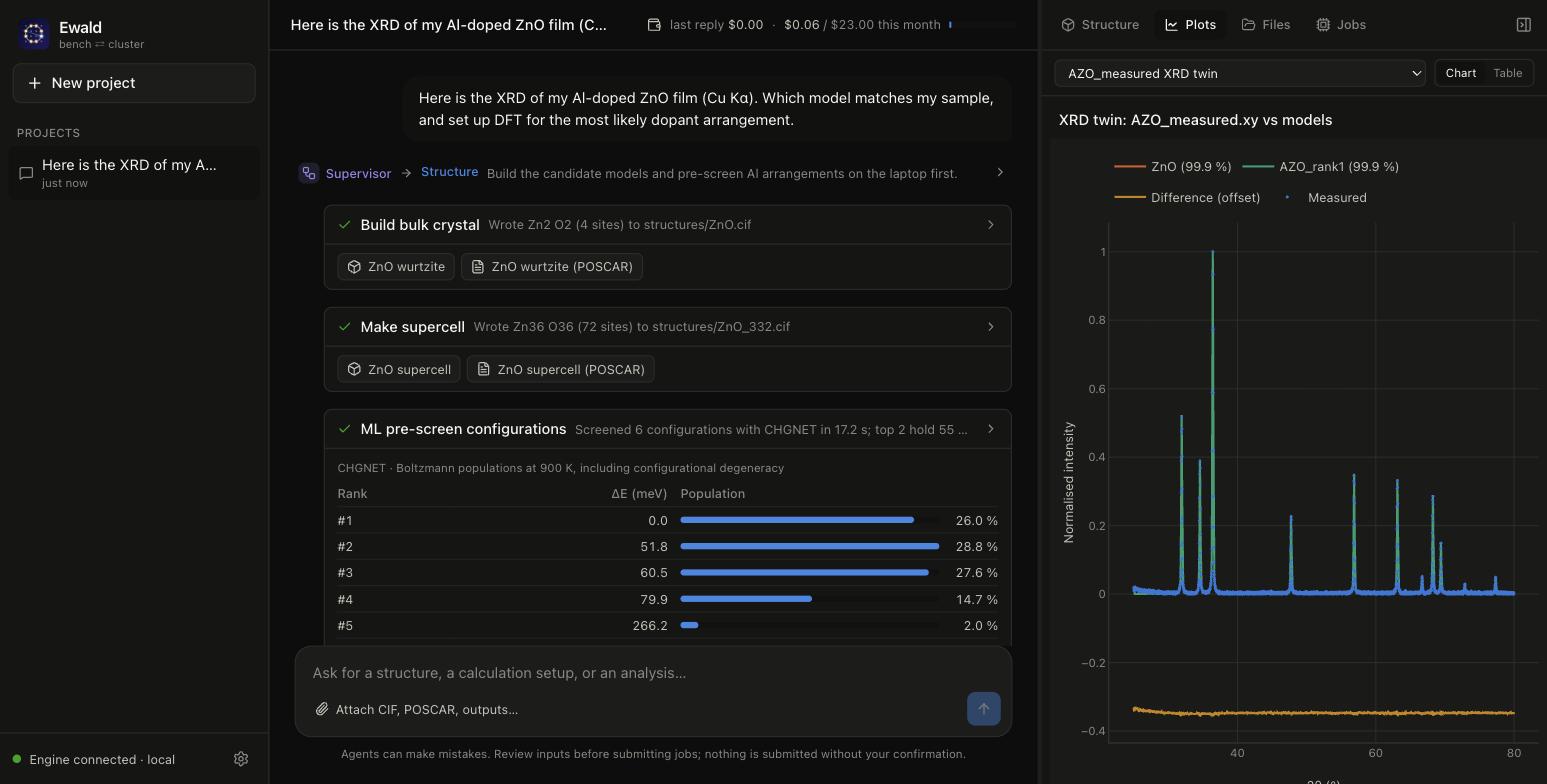
Match your powder diffractogram to candidate models. Fitted lattice strain, zero shift and unexplained peaks tell you which structure you actually made.
Deterministic · no AI tokensScreen on the laptop
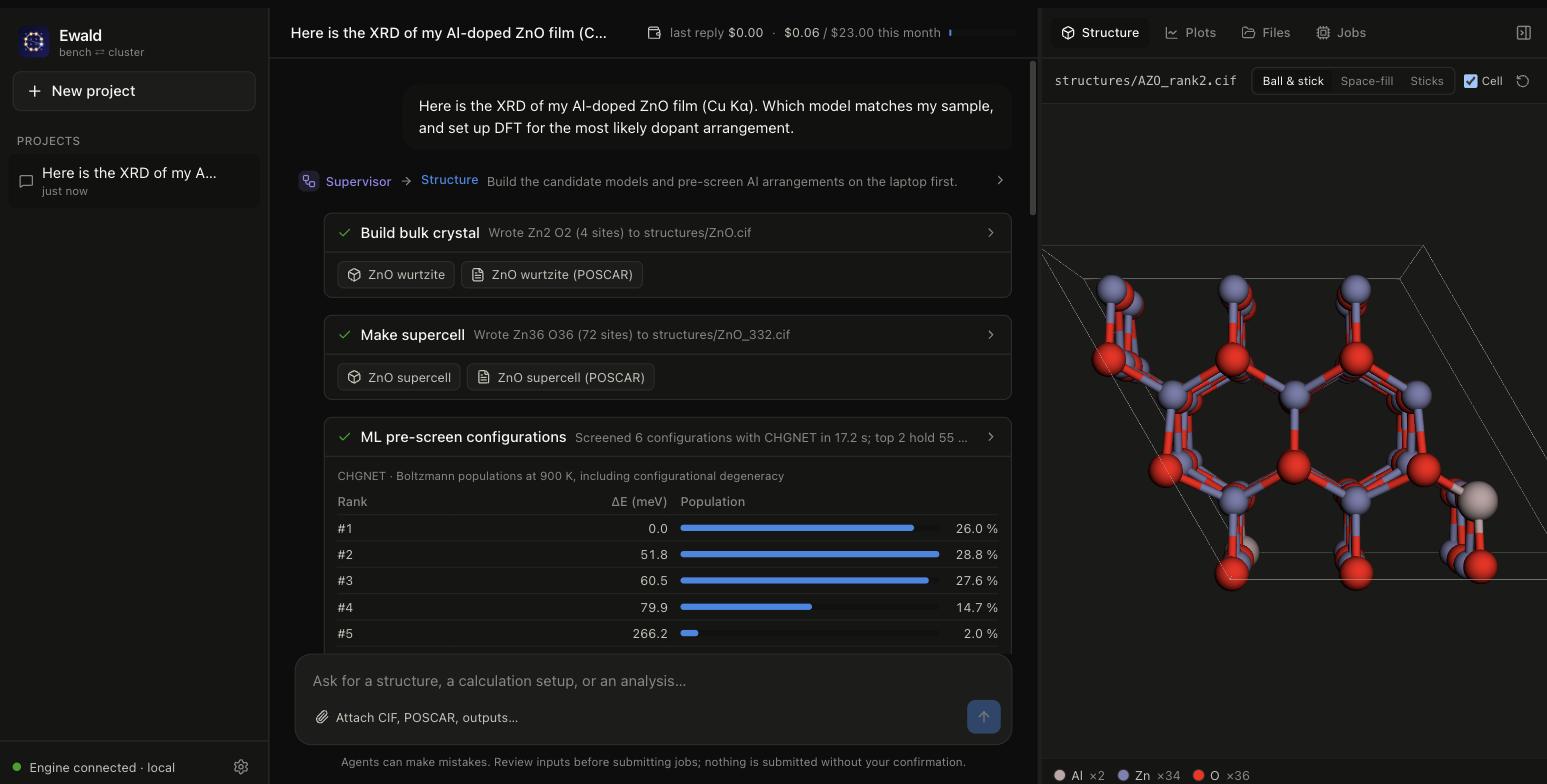
Rank every symmetry-distinct dopant or vacancy arrangement with CHGNet or MACE in seconds, with Boltzmann populations at your synthesis temperature, before any HPC time is spent.
Runs on your CPU · no AI tokensReviewer 2
25 physics rules for VASP and 22 for DFT-FE check every job before submission: smearing, spin, Pulay stress, defect image interactions, MD time steps and more. Critical findings block the job script.
Deterministic · no AI tokensCore-hour oracle
Know what a job costs before you queue it. Estimates start from first principles and calibrate themselves on your lab's own finished runs.
Deterministic · no AI tokensMethods writer
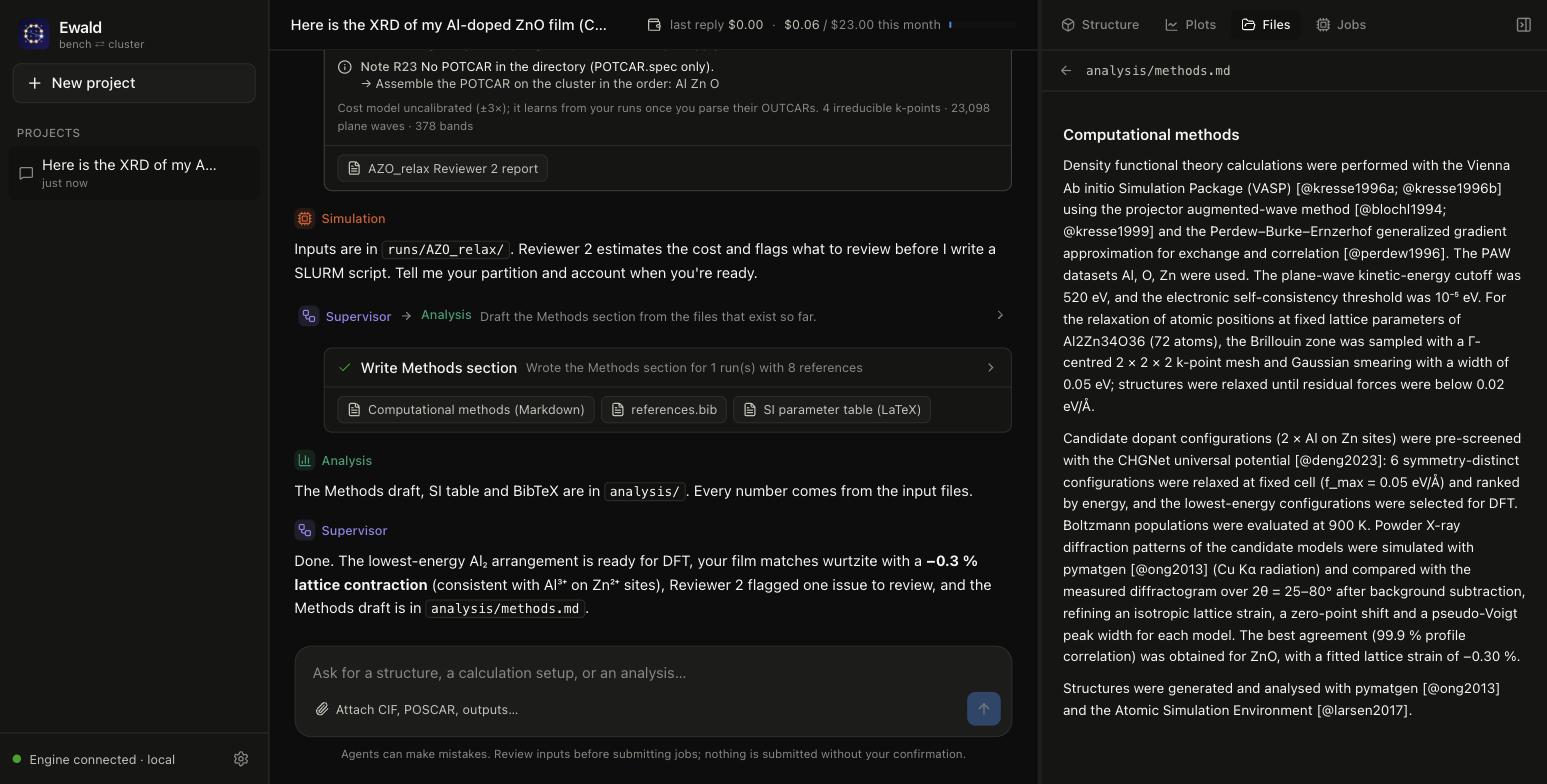
A paper-ready Computational Methods section, SI parameter table and BibTeX, extracted from the actual input and output files rather than written from memory.
Built from your filesLocal-first
Runs on your computer, with conversations encrypted at rest. Outbound traffic is only the text you send to the AI model under your own key, and the searches you make with connectors you switch on; everything else is blocked in software.
Egress guard on by defaultTools without AI
Every calculation also runs by hand from the Tools view: fill in a form, press Run. No API key, no AI and no cost, and the assistant can pick up later from what you did.
Works offline · no AI tokensDatabases, cluster, AI apps
Search and import structures from the Materials Project, COD, NOMAD and more; send prepared runs to your SLURM cluster; or use Ewald's tools from Claude Desktop and other MCP apps.
Off until you switch them onFinite-element DFT, connected
Prepare, audit and read DFT-FE runs: ground state, relaxations, MD, DOS and band structures, with the gap, its type and the band edges read off for you. Run on your cluster, or on your own computer for small cells.
With the DFT-FE developers' agreementConductivity on the laptop
ML-potential molecular dynamics gives Li and Na diffusion coefficients with error bars, the Nernst–Einstein conductivity and the activation energy, with checks that the motion really is diffusive.
Runs on your CPU or GPU · no AI tokensFrom partial occupancy to models
Turn a CIF with mixed or partially occupied sites into charge-neutral ordered supercells, enumerated exactly by symmetry and ranked electrostatically and with an ML potential.
Deterministic · no AI tokensYour tools, your potentials
Drop in a plugin to add your own tools, or register a CHGNet or MACE model fine-tuned on your DFT without writing code. Plugins stay off until you approve them.
Tamper-checked by SHA-256Your measurement is the ground truth.
Drop in an .xy or .csv diffractogram. Ewald simulates the pattern of every candidate model, refines strain, zero shift and peak width against your data, and ranks the models.
- Penalises fits that need implausible strain
- Flags unexplained peaks as possible secondary phases
- Reports lattice expansion or contraction as evidence of dopant incorporation
Seconds on a laptop, before weeks on a cluster.
A universal machine-learned potential relaxes and ranks every symmetry-distinct arrangement of your dopants or vacancies. Only the configurations that matter go to DFT.
- Six Al₂ arrangements in a 72-atom ZnO cell: about 20 s with CHGNet on a MacBook Air
- Boltzmann populations at your synthesis temperature, including degeneracy
- Interactive 3D viewer for every structure
Meet Reviewer 2, before Reviewer 2 meets you.
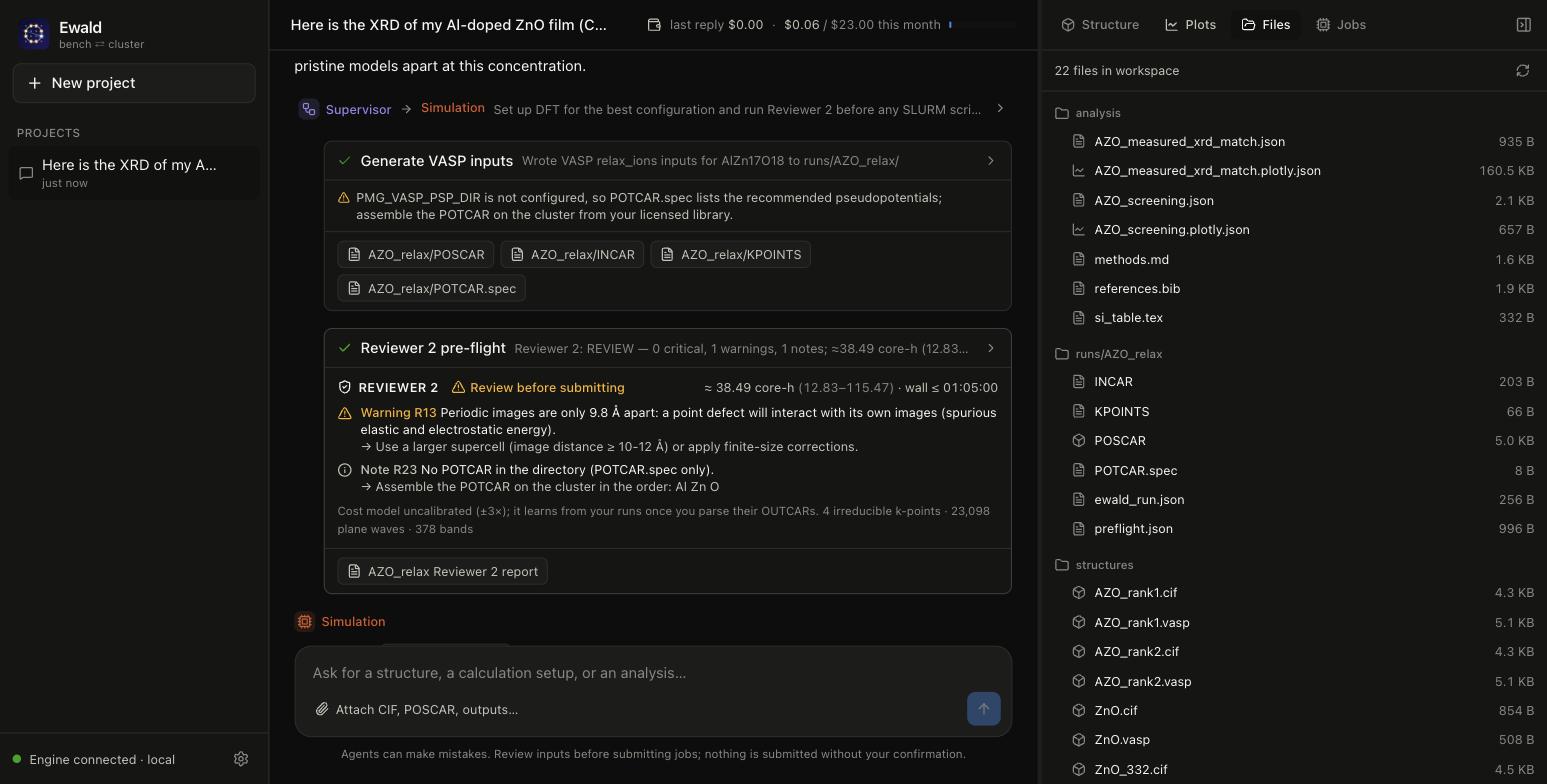
Deterministic physics checks and a core-hour estimate for every job. Critical problems block the SLURM script until they are fixed or you explicitly accept them. The AI proposes; the physics rules decide.
- Tetrahedron smearing on a metal
- POTCAR order ≠ POSCAR
- Missing spin polarisation
- Pulay stress
- Defect image interaction
- Low k-point density
- Missing DFT+U
- Unsafe MD time step with H
A Methods section that matches what ran.
Functional, cutoff, k-mesh, smearing, convergence criteria, ML pre-screening and XRD refinement, with the right citations, generated from the files that ran. Plus an SI table in LaTeX and a BibTeX file.
One conversation, from bench to cluster.
Ask in plain language. Specialist agents for structures, experiments, simulations and analysis hand off to each other, and every step is visible, checkpointed and reversible.
- Upload your diffractogram, for example of an Al-doped ZnO film measured with Cu Kα.
- The structure agent builds wurtzite ZnO and a 72-atom supercell, and ML-screens Al₂ arrangements at 900 K.
- Experiment Twin fits your pattern: single-phase wurtzite, lattice contracted by 0.30 %, consistent with Al³⁺ on Zn²⁺ sites.
- The simulation agent writes DFT inputs for the most populated arrangement; Reviewer 2 flags that periodic images are only 9.8 Å apart and estimates the core-hours.
- The analysis agent writes the Methods section, citing the ML potential, the XRD refinement and every DFT parameter used.
Unpublished data stays unpublished.
Built for groups and R&D teams that can't send structures to someone else's cloud.
- Local engine. Structures, inputs and outputs live on your computer. The engine listens only on your own machine, behind a per-launch token.
- Egress guard. Every outbound connection except the AI model API you chose is blocked in software.
- Your key, your keychain. Bring your own Anthropic or OpenAI key, stored in the OS keychain, with a live budget meter and a hard monthly cap.
- Full provenance. Every project is checkpointed locally, so you can see exactly what was done and why.
Standing on excellent shoulders.
The individual pieces exist, and Ewald builds on many of them. What's new is the combination, and who it's for.
What already exists
- Workflow engines for computational experts (atomate2, AiiDA, pyiron)
- Input-set libraries (pymatgen) and after-the-fact error handlers (custodian)
- Universal ML potentials (MACE, CHGNet, M3GNet, SevenNet, ORB, MatterSim)
- Rietveld and phase-identification software
- Research LLM agents for chemistry and materials
What Ewald puts together, locally, for non-programmers
- Model choice anchored to your own measured data
- ML-potential triage before any DFT is run
- A deterministic pre-submission audit that gates job creation
- A cost model that learns from your lab's own runs
- A Methods section generated from files, not from memory
Simple pricing. Bring your own AI key.
You pay the AI provider directly for tokens, typically $0.10–0.25 for a multi-step request. Ewald's price covers the software.
For students and individual academics.
- Structure, simulation and analysis agents
- Reviewer 2 audits
- VASP and LAMMPS inputs, SLURM scripts
- Community support
Academic. $79 / month commercial. Annual billing: 2 months free.
- Everything in Explore
- Experiment Twin (XRD)
- Laptop ML pre-screening
- Cost oracle and Methods writer
- Email support
Academic, up to 10 seats. Commercial from $799 / month.
- Everything in Pro
- Shared cost-oracle calibration across the lab
- Priority support
- Onboarding call
For industrial R&D.
- Air-gapped deployment with your own model endpoint (Bedrock, Vertex, Azure)
- SSO and validation documentation
- Custom workflows and SLA
Founding labs: Pro is free during the beta, then 50 % off for life, in exchange for honest weekly feedback.
Prices in USD, excluding applicable taxes. Ewald does not include VASP; running VASP requires your own license.
Questions scientists ask us.
Do I need a VASP license?
Only to run VASP. Ewald writes VASP inputs and job scripts that you run on your own cluster under your own license; it doesn't ship VASP or its pseudopotentials. Experiment Twin, ML pre-screening, Reviewer 2 and LAMMPS (open source) work without one.
Which AI key do I need, and what does it cost?
Your own Anthropic (recommended) or OpenAI API key. You pay the provider directly: typically $0.10–0.25 for a multi-step request, less with smaller models. A live budget meter shows the cost of every reply and enforces a monthly cap you set.
Where does my data go?
It stays on your computer. The only data that leaves is the text of your conversation (and tool results) sent to the AI provider you chose, under your own key and their API terms. There is no telemetry, and an egress guard blocks every other outbound connection.
Which operating systems are supported?
macOS on Apple silicon, Windows 10 and 11 (64-bit), and 64-bit Linux (.deb or .rpm). Beta builds are not yet code-signed, so your OS will ask you to confirm the first launch.
Will it submit jobs to my cluster on its own?
No. Nothing is submitted without your confirmation, and a job script can't even be generated while Reviewer 2 has an unresolved critical finding.
Can I trust the results?
Treat Ewald like a very fast, careful colleague whose work you still check. The physics (XRD simulation, fitting, ML relaxations, the audit, the cost model, the Methods extraction) is deterministic code; the AI plans and explains. ML energies are a screen, not a final answer, and every step is visible so you can verify it.
What happens after the beta?
Explore stays free. Founding labs keep Pro at 50 % off for life. We'll give plenty of notice before paid plans start.
Can we use it in industry, or air-gapped?
That's what the Enterprise plan is for: deployment inside your own network, pointed at your organisation's model endpoint (for example through AWS Bedrock, Google Vertex or Azure), with SSO and validation documentation. Get in touch to discuss your setup.
Ewald is by invitation for now.
We're working closely with a small group of labs before a public release. Invited testers get a test edition to try the Experiment Twin on their own diffraction data; founding labs get the full workbench, including DFT-FE, the connectors and plugins, set up with us personally.
Already testing? Tell me what worked and what didn't: send feedback by email.
Become a founding lab.
We're onboarding a small group of experimental groups for the beta. Tell us about your materials, instruments and cluster, and we'll set you up personally.
Apply for the betaOpens your email app with a short template. Prefer to write yourself? rajdeepboral160101@gmail.com